Agent Skills and Harness Engineering
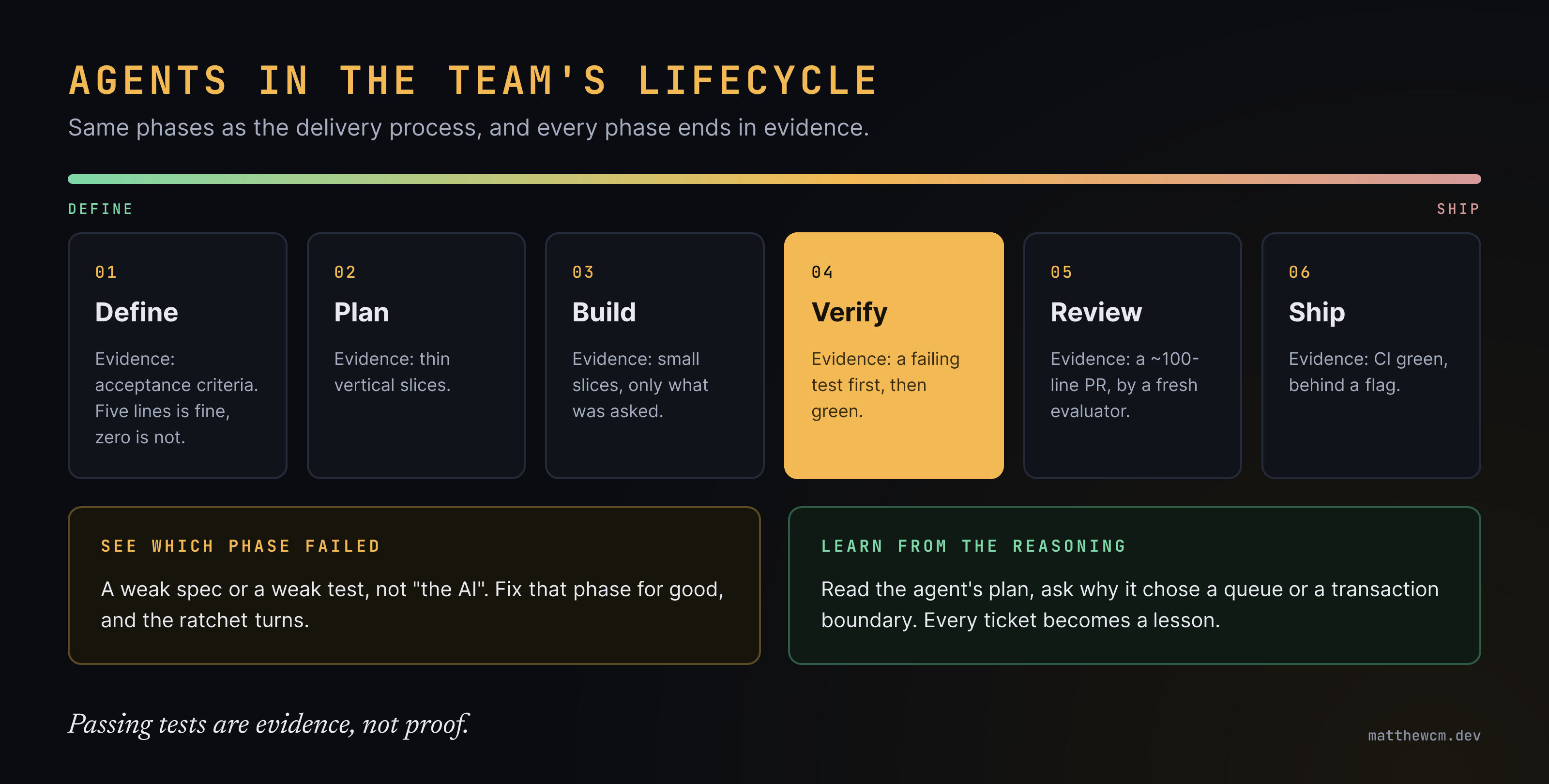
Agent = model + harness. Skills turn an agent's work into the same phased lifecycle a delivery team already runs (define → plan → build → verify → review → ship), with evidence at every phase, so you can see which phase failed, teams adopt AI through a process they trust, and developers learn from the agent's reasoning.
🌱 A rough idea, planted recently. Expect rough edges — it will grow.
On this page
[!abstract] In one sentence Agent = Model + Harness. The scaffolding around the model (skills, AGENTS.md, hooks, tools, sandbox, a separate evaluator) matters as much as the model does, and the best scaffolding looks like a good delivery process.
Notes on two posts by Addy Osmani: Agent Harness Engineering (April 2026) and Agent Skills (May 2026).
Harness engineering: the “why”
- The harness is everything that isn’t the model: system prompt, AGENTS.md/CLAUDE.md, skills, tools and MCP servers, filesystem, git and sandbox, subagents and routing, hooks, observability. “If you’re not the model, you’re the harness.”
- The gap is often the harness, not the model. The same model scores very differently in different harnesses. One team moved a coding agent from the top 30 to the top 5 on Terminal Bench by changing only the harness.
- Work backwards from behaviour. Name the behaviour you want, then add the piece that produces it: durable work → git, safe execution → a sandbox, long tasks → planning, verification and context resets. A component without a named job shouldn’t exist.
- The ratchet. Every agent mistake becomes a permanent rule, hook or review check. For example, a merged PR with a skipped test leads to an AGENTS.md rule, a pre-commit grep for
.skip(, and a review check. Remove scaffolding when a better model makes it unnecessary. - Separate the generator from the evaluator. Agents grade their own work too kindly. Agree what “done” means before coding starts.
- Hooks for the non-negotiables: success is silent, failures are verbose. Keep AGENTS.md short, with every line traceable to a real failure: “pilot’s checklist, not style guide.”
- Fight context rot: compaction, offloading big tool outputs to disk, progressive disclosure, and full resets from a hand-off file.
- Failure modes to design for: stopping early, poor decomposition, incoherence across sessions, self-grading, context rot, destructive commands, prompt injection through tool descriptions, and claiming “finished” on broken code.
Agent skills: the “how”
Agents take the shortest path to “done” and skip the senior work that doesn’t show in the diff: specs, tests, scope control and reviewability. A skill is a markdown workflow (steps → checkpoints that produce evidence → an exit criterion), loaded only when relevant and chosen by a small router skill.
| Phase | Command | Delivery-process equivalent |
|---|---|---|
| Define | /spec | Statement of work, acceptance criteria, Definition of Ready |
| Plan | /plan | Refinement, vertical slices, INVEST |
| Build | /build | Implementation in small slices |
| Verify | /test | Test pyramid, failing test first |
| Review | /review | ~100-line PRs with Critical/Nit/Optional/FYI labels |
| Ship | /ship | CI/CD, feature flags, Definition of Done |
Five principles:
- Process over prose.
- Anti-rationalisation tables, i.e. pre-written rebuttals: “too simple for a spec” → five lines is fine, zero is not; “tests pass, ship it” → passing tests are evidence, not proof.
- Verification is non-negotiable.
- Progressive disclosure.
- Scope discipline: “the single biggest determinant of whether an agent’s PR is mergeable.”
You can adopt these without installing anything:
- Write down your team’s rationalisations and their rebuttals.
- Turn long process documents into short checkpointed workflows.
- Make evidence the exit of every task.
- Add five non-negotiables to AGENTS.md: surface assumptions, stop on conflicting requirements, push back, prefer the boring solution, touch only what’s asked.
My take: agents as a delivery process
- It’s easier to understand. If the agent works in the same phases as the team, anyone who knows the delivery process can review its output. Nobody needs a new mental model.
- You catch problems in the right phase. Each phase ends in evidence, so when something goes wrong you can see which phase failed: a bad spec, a bad plan, a weak test or a missed review. Then you fix that phase (the ratchet) instead of blaming “the AI”.
- It helps developers adopt AI. People trust a process they already run. Mapping skills onto existing ceremonies (ready, refinement, review, done) makes AI an accelerator of the team’s process, not a parallel one. It also helps with a common friction: tickets picked up before they’re ready. An agent that won’t build without acceptance criteria enforces readiness for you.
- You can learn the backend deeply. The phase outputs (spec, plan, tests, review notes) and the agent’s reasoning are teaching material. A front-end developer can read the plan, ask the agent why it chose a queue or a transaction boundary, and challenge it, so every task becomes a lesson (Growing Frontend Engineers into Backend). The habit to keep is slowing down to understand, not just accepting the output.
Related ideas:
- The ratchet is the agent version of fitness functions.
- Skills are Golden Paths for agents.
- The generator/evaluator split is the idea behind Don’t Read the Code? Verifying AI-Written Code.
- Scope discipline and hooks are the executable-rules layer of A Safe Path for AI Agents in a Large Codebase.
- #ai-agents
- #harness-engineering
- #agent-skills
- #ai-adoption
- #ways-of-working
↩ Linked from (1)
…er letting one session write both the tests and the code, and "done" includes deleting the old path. Related: Agent Skills and Harness Engineering · Don't Read the Code? Verifying AI-Written Code · Architecture Fitness F…
↪ Links to (6)
Related by topic
- Growing
DORA Metrics
Platform engineering - Seed
Explore, Expand, Extract
Platform engineering - Seed
From Statement of Work to Done: Requirements Both Ends Can Build From
Career - Growing
Where Platforms Fit: DDD Subdomains
Platform engineering